On this page8 min read
The client and the results Results at a glance
The company started with Copilot and nothing else. This is what changed in three parts of the business.
- Client
- A mid sized Toronto company, name withheld
- Company
- Non technical, several brands
- Starting point
- Copilot only, no agents
- Systems
- NetSuite, Power BI, a project tool
120+
Demand planninghours of manual work saved every monthThat is more than three 40 hour work weeks, every month
4 → 2
Customer servicestaff for the same workload
Real time
Managementproject status, straight from the project toolStatus slides built automatically
What DevToDollars did
- Discovery and assessment
- Automated status reports
- AI agents
- Data pipelines
- Team training
- Access and data governance
The starting point Core processes ran on exports, Excel and memory
Before DevToDollars came in, AI at the company meant Copilot: something staff asked for help, never an agent that could take a task and finish it inside the company's own systems.
Excel by hand
Staff worked through thousands of exported rows by hand in Excel, and errors crept into the results.
Every department on its own
Each department had its own processes, data sources and tools, so their data did not always agree.
Status from memory
The project tool was out of date, so the PMO (the team that tracks projects) built its status slides by hand, from memory. That meant management could not see which projects were late, by how much, or why.
Leadership knew all of this, and had measured it. What it lacked was someone to fix it. It was also wary of AI: without clear rules, it worried AI could affect the company's tools and data.
- Nearly9 in 10
- use AI regularly somewhere in the business
- Only22%
- of companies under $1 billion in revenue say they are scaling AI agents
Source: McKinsey, The state of AI in 2026, August 2026.
- At least86%
- of the spreadsheets checked in field audits had errors
Source: Raymond Panko, Spreadsheet Errors: What We Know. What We Think We Can Do, EuSpRIG, 2000.
Discovery and assessment First, a map of how every department works
DevToDollars did not start by building anything. Its team sat down with each department's leaders and senior managers, asked them all the same four questions, and mapped how each department works today and where its time goes.
Which departments share data with each other?
Which workflow takes each department the longest?
Which outside tools does each project rely on?
How does each department do its work today, in detail?
What the answers showed
Fix the data first
Data sources that disagreed had to be fixed before any AI went in, or the AI would only repeat their mistakes.
Prepare each team
Every department had cultural needs, not only technical ones, to settle before AI rolled out.
Start with the biggest win
That set the order of work: begin wherever the impact would be highest.
- Gartner predicts60%
- of AI projects without data ready for AI will be abandoned through 2026
Source: Gartner press release, February 2025.
The solution No single tool was forced on every team
With the order of work set, DevToDollars took each department's longest workflow on its own terms. AI agents fit the PMO and marketing. Demand planning needed plain code.
AI agent
PMOStatus reports built from the project tool
AI agents
MarketingCampaign updates pulled from the web
Plain code
Demand planningPipelines that feed the forecasting models
PMO reporting AI agent
Status slides, no longer built from memory
The PMO used to build every status slide by hand. Now an AI agent reads each major project's stages from the project tool and builds the slide, so management sees every project as it stands.
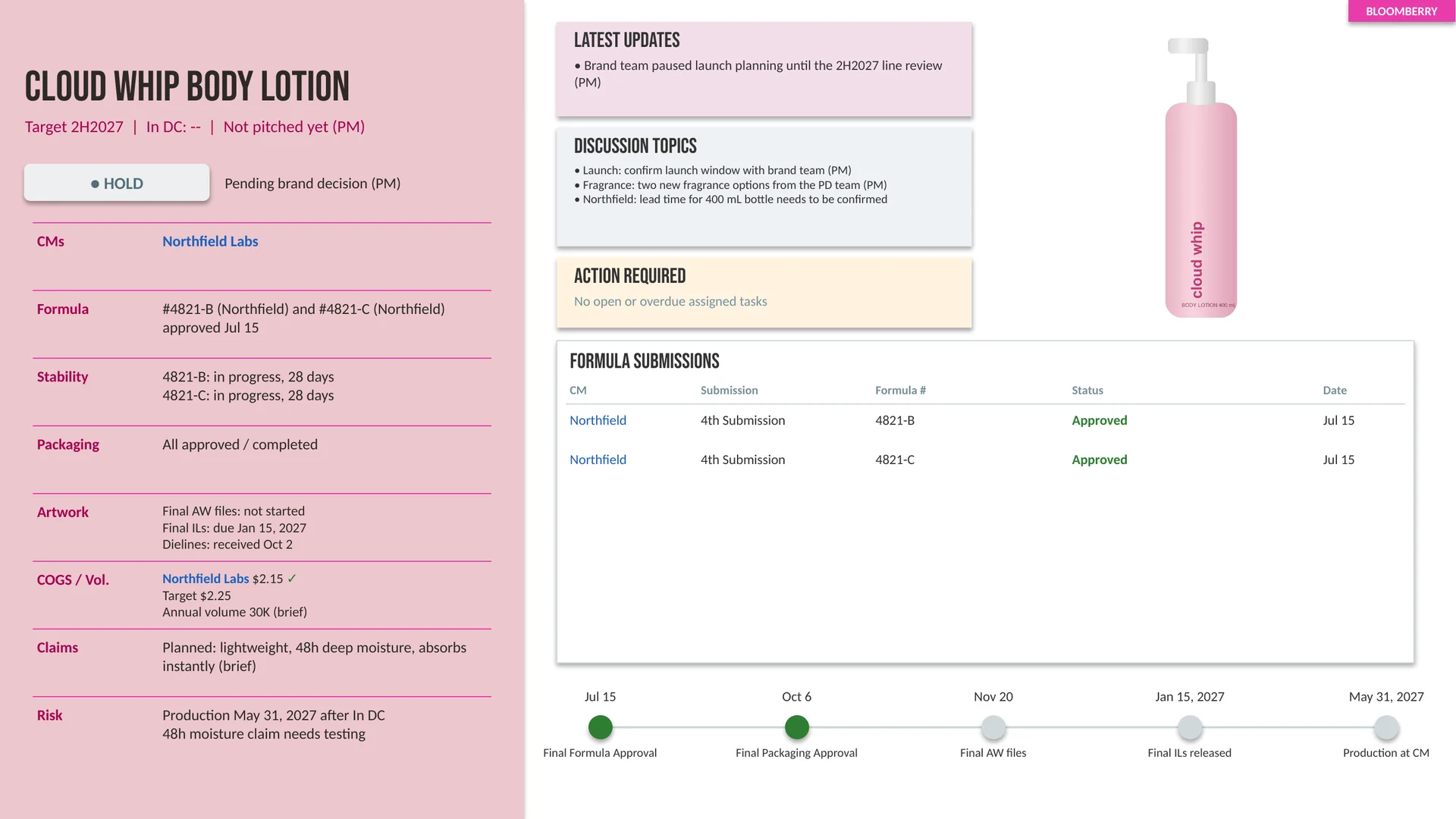
In development. This product is on hold while the brand team decides. Its formula submissions sit on the right and its milestones along the bottom.
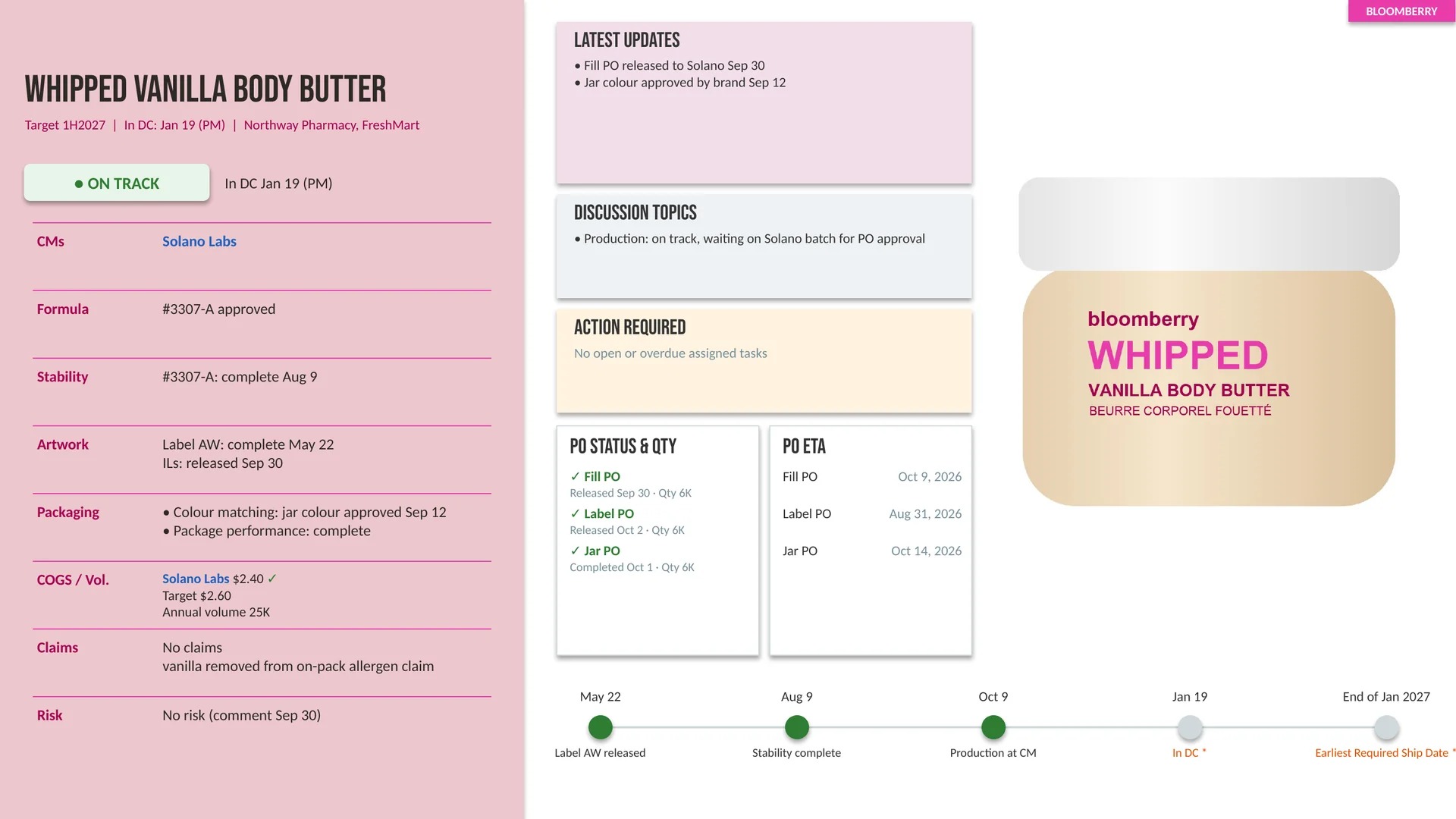
In production. This one is on track. Once a product is in production, purchase orders take the place of formula submissions, and the milestones run up to the earliest required ship date.
How ICM works
ICM, short for Interpretable Context Methodology, is an open method that splits a job into small written steps. Anyone can follow what the agent did, the steps that need no AI run as plain scripts, and a person reviews each stage.
Marketing AI agents
Agents the team learned to train
The PMO agent works from data the company already holds. Marketing needed the opposite: research from outside, keeping up with the latest updates on marketing campaigns. Semi autonomous agents now pull those updates from the web.
Search
The agents search the web for the latest campaign updates.
Remember
Hermes Agent, open source from Nous Research, keeps a memory and refines its own skills.
Train
DevToDollars coached the marketing team to train the agents themselves, so the results match what the team is looking for.
Demand planning Plain code
Plain code where AI was not needed
Demand planning did not need an AI agent. It needed a reliable way to get data into the forecasting models without staff exporting it and feeding it in by hand. DevToDollars wrote code to do exactly that, and introduced new prediction models that forecast more accurately.
Before
- Data exported by hand
- Forecasting models fed by hand
After
- Exports automated
- Pipelines in code feed the models
- New prediction models, more accurate forecasts
Why code here
AI models are paid for by the token, roughly by the word, so every run costs something. Code has no token cost and does the same thing every time. Because DevToDollars builds software as well as agents, it did not have to reach for AI everywhere, and could use whichever tool saved the company more time and money.
- About1 in 5
- companies say AI running costs, tokens included, limit how much they use AI
Source: McKinsey, The state of AI in 2026, August 2026.
A dashboard for management
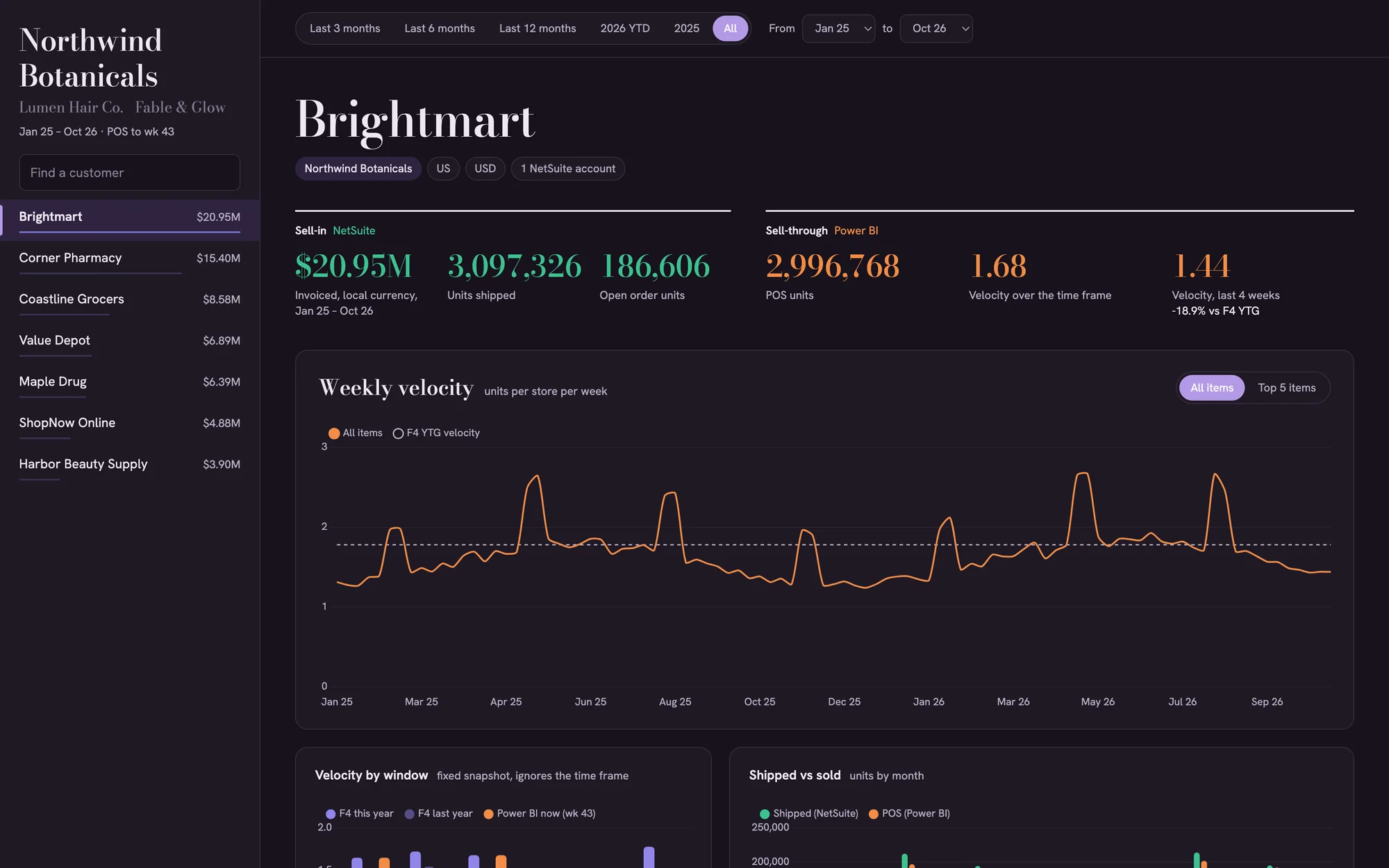
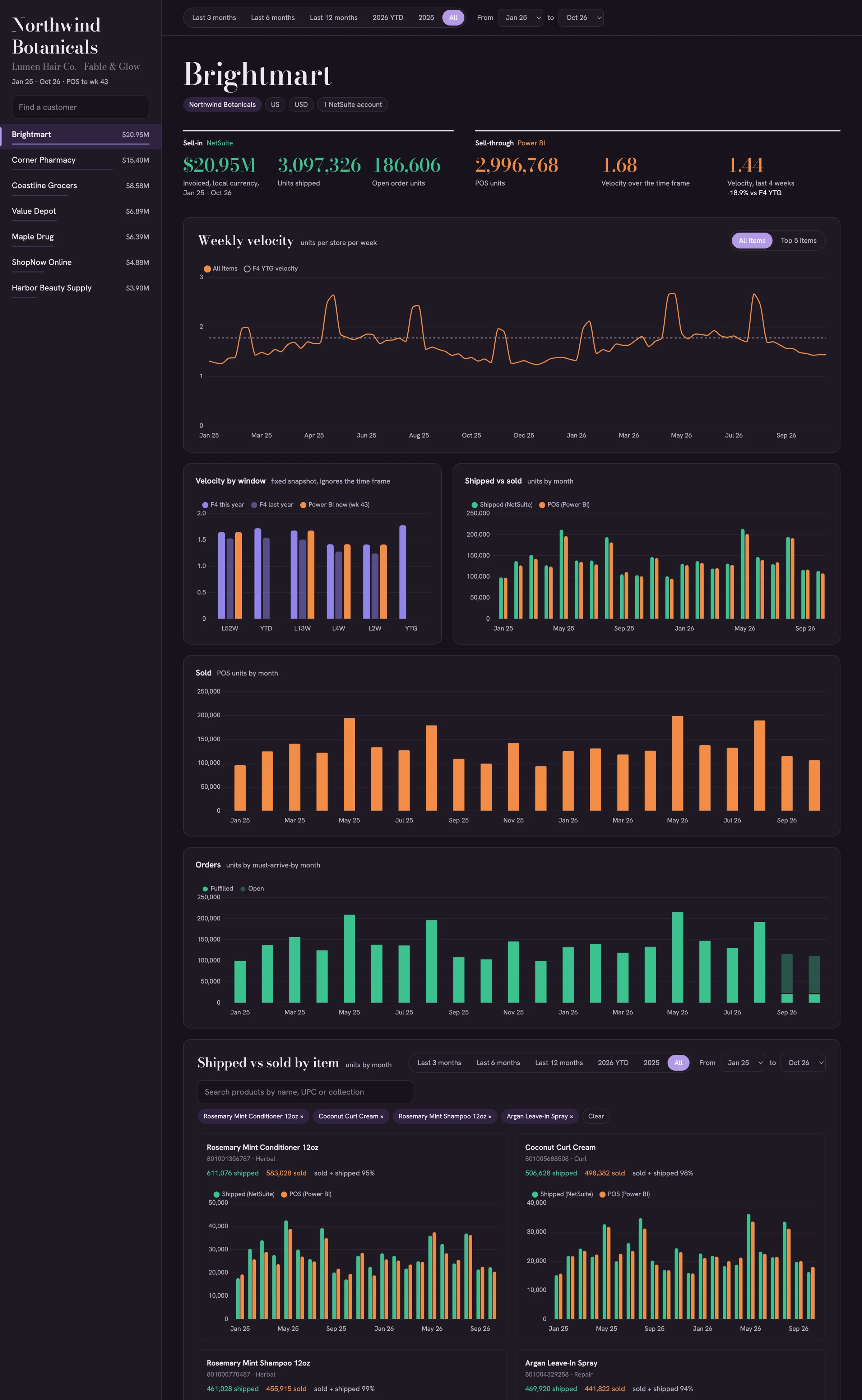
DevToDollars also built a custom dashboard that gives management a bird's eye view of demand planning. It sets what the company shipped to each customer (from NetSuite) beside what that customer sold (from Power BI), on one screen.
- Every retail customer and its invoiced total
- Units sold per store, week by week
Click the dashboard to see it full size. Names are placeholders.
Security, data and governance Where to trust AI, and where not to
With agents now working inside company systems, AI sat close to the company's tools and data, which was leadership's biggest worry from the start. So DevToDollars walked every employee through where AI can be trusted, and where it cannot.
Access
DevToDollars mapped the access each department's AI should have to company software, then set it for every user.
Responsibility
Where an agent can change data in company systems, the person running it is responsible for those changes, and each of those employees was told so.
Data privacy
The company uses an AI provider's enterprise plan, chosen to keep company data protected.
Passwords and keys
The keys the AI uses to reach outside services are kept in secure storage, with guards against attack.
- Of people who use AI at work78%
- bring their own AI tools, which the report says puts company data at risk
Source: Microsoft and LinkedIn, 2024 Work Trend Index, May 2024.
Where to start This company's leaders already knew what was broken, and had measured it.
That head start took it from Copilot alone to agents, pipelines and clear rules. The lesson for similar companies: fix the data before any AI goes in, and use AI only where plain code will not do the job.
Before
- Exports worked through by hand in Excel
- Status slides built by hand, from memory
- Leadership worried about AI near company tools and data
Now
- 120+ hours of manual work saved every month in demand planning
- Slides built from the project tool, so management sees every major project as it stands
- Access set for every user, and the person running each agent answers for its changes
If your leaders know what is broken in your company, the next step is mapping how each department works. DevToDollars starts the way it started here: an assessment, department by department, before anything is built. It suits companies with no one inside who has led AI work before. In Toronto, the team can work on site, alongside the people whose work is changing.